A simultaneous interpreter is the professional who translates a speech into another language while the speaker is still talking, almost always from a soundproof booth, wearing headphones, and with a delay of just a few seconds. They are hired for conferences, shareholder meetings, press conferences, and international meetings, and increasingly for Zoom or Teams meetings, where they work remotely.
In this article, we explain what their job looks like from the inside, why they never work alone, what equipment they need, and how much they cost in Spain based on rates published by agencies and university foundations, checked in September 2026. We also look at when it pays to hire one and when an automatic tool is enough. Where we haven’t found public data, we say so.
In short
- A conference, a negotiation, or a press event? → professional interpreters, two per language if it lasts more than an hour and a half.
- An online meeting with attendees from several countries? → remote interpreters using the language channels in Zoom or Teams.
- Just need to understand a video, a course, or a call yourself? → a voice translator on your PC, with no booth or budget required.
- Budget? → between €540 and €650 per interpreter per day, excluding VAT and equipment.
In this article
- What a simultaneous interpreter does in a workday
- Why interpreters always work in pairs
- A, B, and C languages: how language combinations are organized
- The equipment: booth, portable system, or remote interpretation
- How much a simultaneous interpreter costs in Spain
- When to hire an interpreter and when a machine is enough
- How to become a conference interpreter
- The most common mistakes when hiring simultaneous interpretation
- More questions about the simultaneous interpreter
- So, which one do we use?
What a simultaneous interpreter does in a workday
What the audience sees is someone talking with headphones on. What they don’t see is that half the work happens before the event begins. A simultaneous interpreter asks for the program, the list of speakers, the presentations, and any documents that will be read. With that, they prepare a glossary: acronyms, product names, job titles, technical terms, and figures they know will come up.
Preparation is not an extra. Interpreting isn’t just swapping words from one language to another; it’s understanding an idea and expressing it well in the other language, and that is impossible if the topic is unfamiliar. A speaker talking about pharmacovigilance or financial derivatives uses a vocabulary that no interpreter can improvise reliably. That is why the daily rate includes this time, as explained by the International Association of Conference Interpreters, AIIC.
During the event, the simultaneous interpreter listens to the speaker through their headphones and speaks into their microphone, which reaches the audience’s receivers. They are always a little behind, at just the right distance to understand the sentence before reformulating it: if they get ahead, they make mistakes; if they fall behind, they lose the thread. Meanwhile, they monitor their own voice, keep an eye on the room’s screen, and stay alert to any program changes.
When finished, the simultaneous interpreter usually leaves nothing in writing. Simultaneous interpretation is oral and ephemeral: it is not a document translation or a set of minutes. If a transcript or recording in each language is needed, it is agreed upon separately, as it involves different rights and additional work.
Why interpreters always work in pairs
Listening in one language, understanding, reformulating, and speaking in another, all at the same time, requires a level of concentration that cannot be sustained for more than 20 or 30 minutes straight. The AIIC branches explain this in their frequently asked questions, and it is the reason there are two people taking turns in each booth. After that time, omissions and inaccuracies begin, and the audience notices them even if they don’t know where they come from.
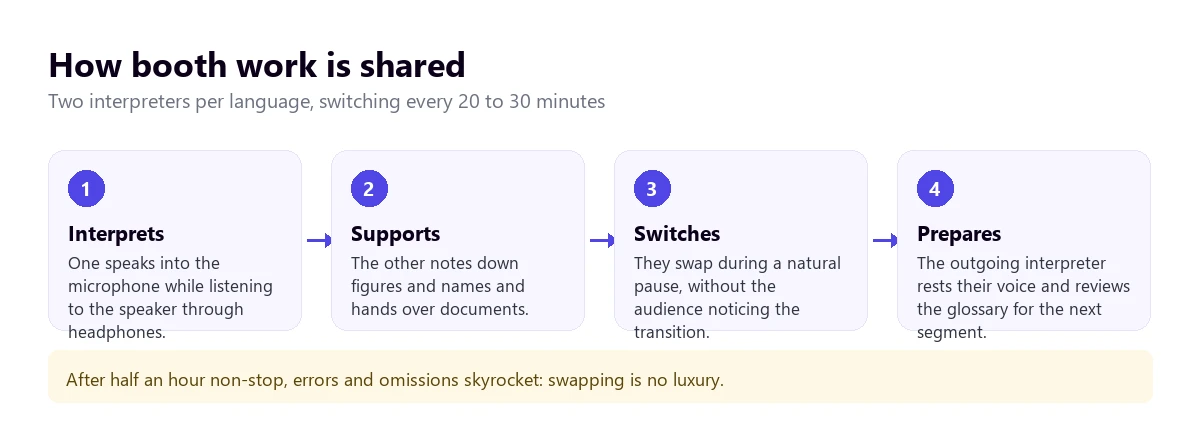
The partner who isn’t speaking doesn’t leave either: they are still the second simultaneous interpreter in the booth. They follow the speech, write down figures and names on a piece of paper for the other to read, look for the document the speaker started reading without warning, and are ready to step in if the one speaking loses their voice. The switch is made during a natural pause, and when done well, the audience doesn’t notice.
This rule translates directly into the budget. Two of the three Spanish rates we checked state it in writing: two interpreters for anything over an hour and a half of simultaneous interpretation. A full day in one language combination is, therefore, two interpreter days. Anyone who asks for a price and sees a single figure is usually looking at half the cost.
A, B, and C languages: how language combinations are organized
A simultaneous interpreter doesn’t just “speak languages.” Their profile is described using a classification used by the profession and listed in the AIIC directory. The A language is their native language or equivalent, into which they interpret with complete naturalness. A B language is a language they master so well that they also interpret into it. A C language is a language they understand perfectly, but from which they only interpret into their A language.
In practice, the most common setup is for each interpreter to work into their native language. In a conference between the US and Germany, the American booth interprets from German into English, and the German booth from English into German. When the market doesn’t support two booths, interpreters who also work into their B language are hired, which in the trade is called doing a “retour.”
What if there are six languages in the room? No simultaneous interpreter covers all combinations, so a relay is used: one booth interprets from the speaker’s language into a common language, and the others take that version as the source for their language. It works, but each step adds a few seconds of delay and the possibility of carrying over an error. In organizations with many languages, it is an everyday occurrence; in a private event, it is best avoided if possible.
The equipment: booth, portable system, or remote interpretation
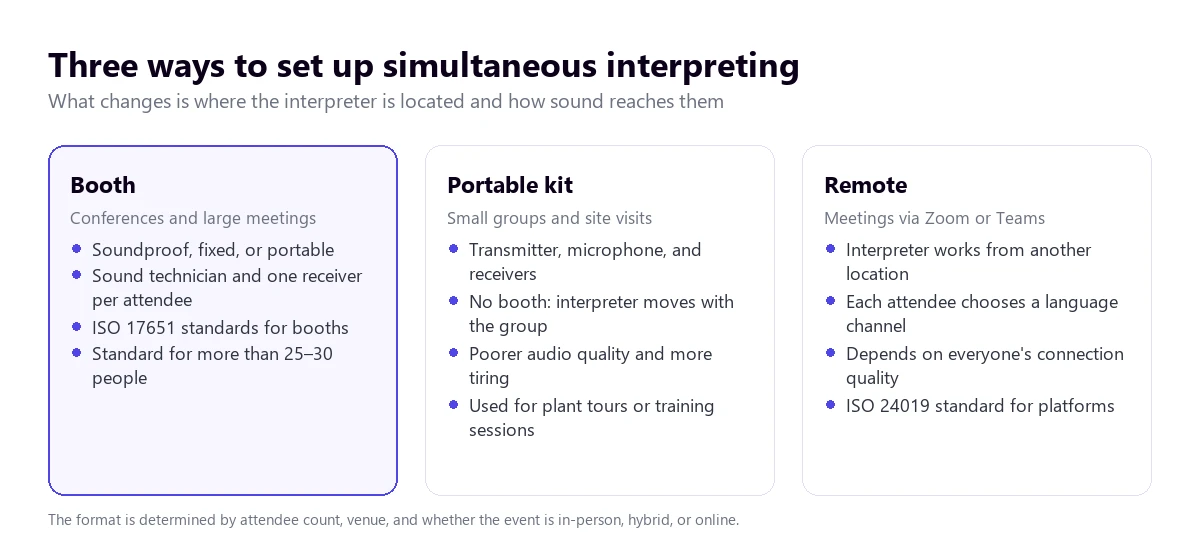
Simultaneous interpretation requires the interpreter to receive clean sound from the room and for their voice to reach each attendee. There are three ways to achieve this, and the budget changes significantly from one to another.
Booth
This is the format for conferences and the one any simultaneous interpreter prefers. The booth is soundproof, has a direct view of the room and one console per interpreter, and receives the sound from the speakers’ microphones. ISO 17651 standards set the requirements for fixed and mobile booths. You need a sound technician throughout the event and a receiver with an earpiece for each attendee. Rental companies recommend it for 25 to 30 people or more, or when there are multiple language combinations.
Portable system
For factory tours, small training sessions, or walk-throughs, a portable system is used: a transmitter with a microphone for the interpreter and receivers for the group. It requires no installation, but the interpreter hears the speaker less clearly, gets tired sooner, and background noise creeps in. It is a solution for small groups and short sessions, not for a full day of conferences.
Remote
Remote simultaneous interpretation has become standard in online meetings. Zoom allows the host to designate up to 200 participants as interpreters, with nine default languages and the option to add custom languages, on Pro, Business, Education, or Enterprise accounts. Teams has the “Language Interpretation” feature, with up to 16 language pairs, but its help section is clear: Microsoft doesn’t provide the interpreters; the organization hires them, and they must connect from the desktop app. We explain it step by step in our guides for Zoom and the Teams interpreter.
Remotely, the biggest risk isn’t the simultaneous interpreter; it’s the sound. A speaker using their laptop microphone with an unstable connection reaches the booth sounding choppy, and what can’t be heard can’t be interpreted. The ISO 24019 standard outlines the requirements for platforms doing this work, and serious interpreters ask for a technical test before the event.
How much a simultaneous interpreter costs in Spain
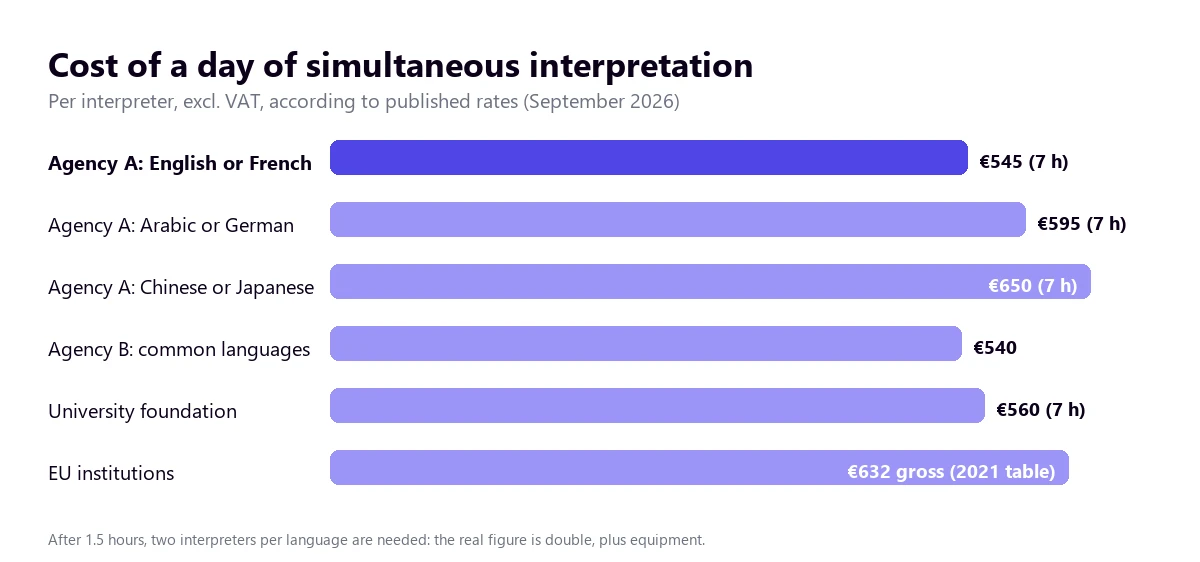
Interpretation rates are not regulated, and each provider sets their own, but several agencies and university foundations in Spain publish theirs. They all charge by the half day or full day, not by the minute, and all prices exclude VAT.
| Source | Half day | Full day | Languages | Notes |
|---|---|---|---|---|
| Dixit (agency) | €450 (4 h) | €545 (7 h) | English, French, Catalan, Galician | €395/€495/€595 in German, Arabic, or Russian; €450/€550/€650 in Chinese, Korean, or Japanese; 2 h minimum |
| ITA Traducciones (agency) | €440 | €540 | English, French, Italian, German, Portuguese, and others | €300 up to an hour and a half; €100 for each extra hour; Chinese upon request |
| General Foundation of the University of Malaga | €450 (4 h) | €560 (7 h) | English and French | €155 per extra hour; two interpreters for anything over an hour and a half |
| EU Institutions (freelance interpreter) | — | €631.97 gross | All | Table from the EU-AIIC agreement in force since July 2021; €455.02 for beginners |
“—” means the source does not publish it. The European figure is the latest public table we found; it may have been updated since then. We haven’t found equivalent public rates in Mexico, so we don’t provide figures for that market.
With this data, you can calculate what a simultaneous interpreter really costs. A conference day in English and Spanish, with two interpreters, comes to about €1,100 plus VAT in fees alone. To that, you have to add the equipment (booth, technician, and receivers), which rental companies quote on a case-by-case basis, plus travel and per diems if the interpreters come from another city. If interpreting goes both ways with two booths, the cost doubles again.
Three details that increase the bill and are worth asking about beforehand: the surcharge for recording or broadcasting (interpretation is a creative work and its distribution is negotiated separately), cancellation terms, and overtime when the event runs long. Sworn interpretation, used in events with legal validity, also carries a surcharge in some rates.
When to hire an interpreter and when a machine is enough
The useful question isn’t whether the machine translates well, but what happens if something is misunderstood. In a negotiation, a medical consultation, a trial, or a press conference, a mistake has consequences, and you need someone who takes responsibility for what they say, understands the subtext, and knows when to ask for clarification.
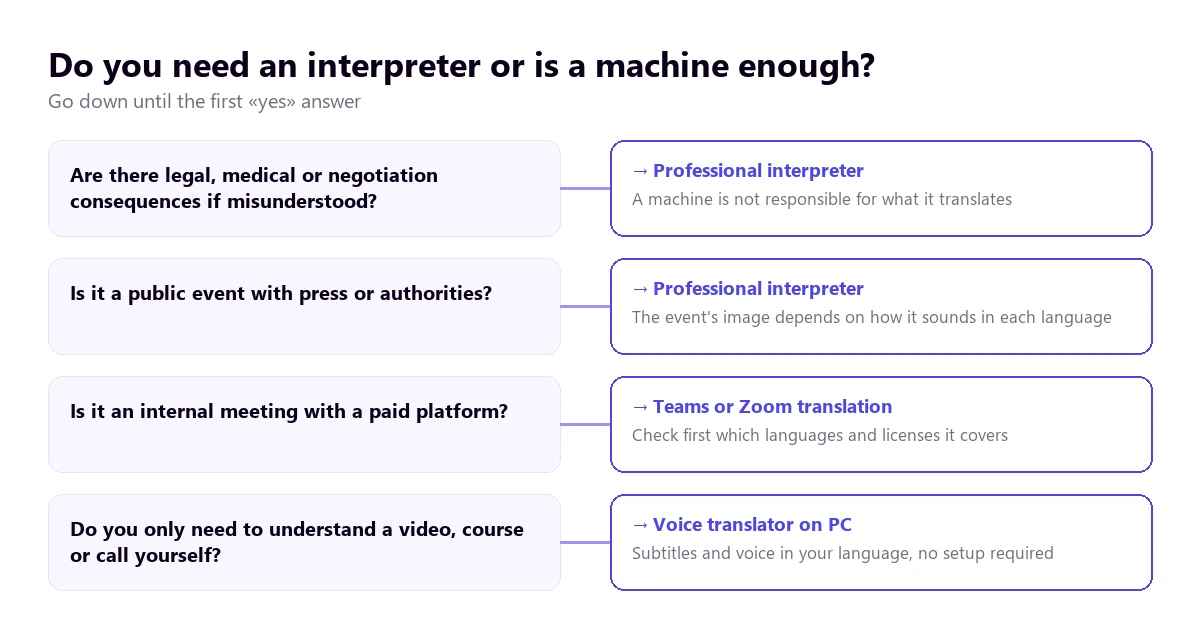
| Option | What it’s for | What it needs | Estimated cost |
|---|---|---|---|
| Voice translator on your PC | Understanding a video, course, or call yourself | A Windows PC | 15 free mins a day; more time is paid |
| Built-in Teams or Zoom translation | Internal meetings in supported languages | Platform license or add-on | Depends on the company’s plan |
| Remote interpreter | Online meetings with multiple languages | Two interpreters per language and a good connection | From about €540 per interpreter per day |
| Booth interpreter | Conferences, public events, negotiations | Booth, technician, and receivers | Fees plus equipment, quoted per event |
There are many cases where a simultaneous interpreter is overkill: following a vendor’s webinar, watching a recorded class in another language, understanding an informal video call, or reviewing a training video. No one is going to set up a booth for that, and that is where an automatic tool makes sense. If you are interested in how they work under the hood and what types exist, we cover it in our article on the simultaneous translator.
The automatic option: a voice translator on your PC
Traducore is ours. It listens to the audio of the app you choose (on Windows 11; on Windows 10, an audio device) and gives you subtitles and voice in your language as it plays, with a three to six-second delay. It has two modes, Video call and Video / talk, and on the Conversation plans it also translates your voice to the other person through a virtual microphone.
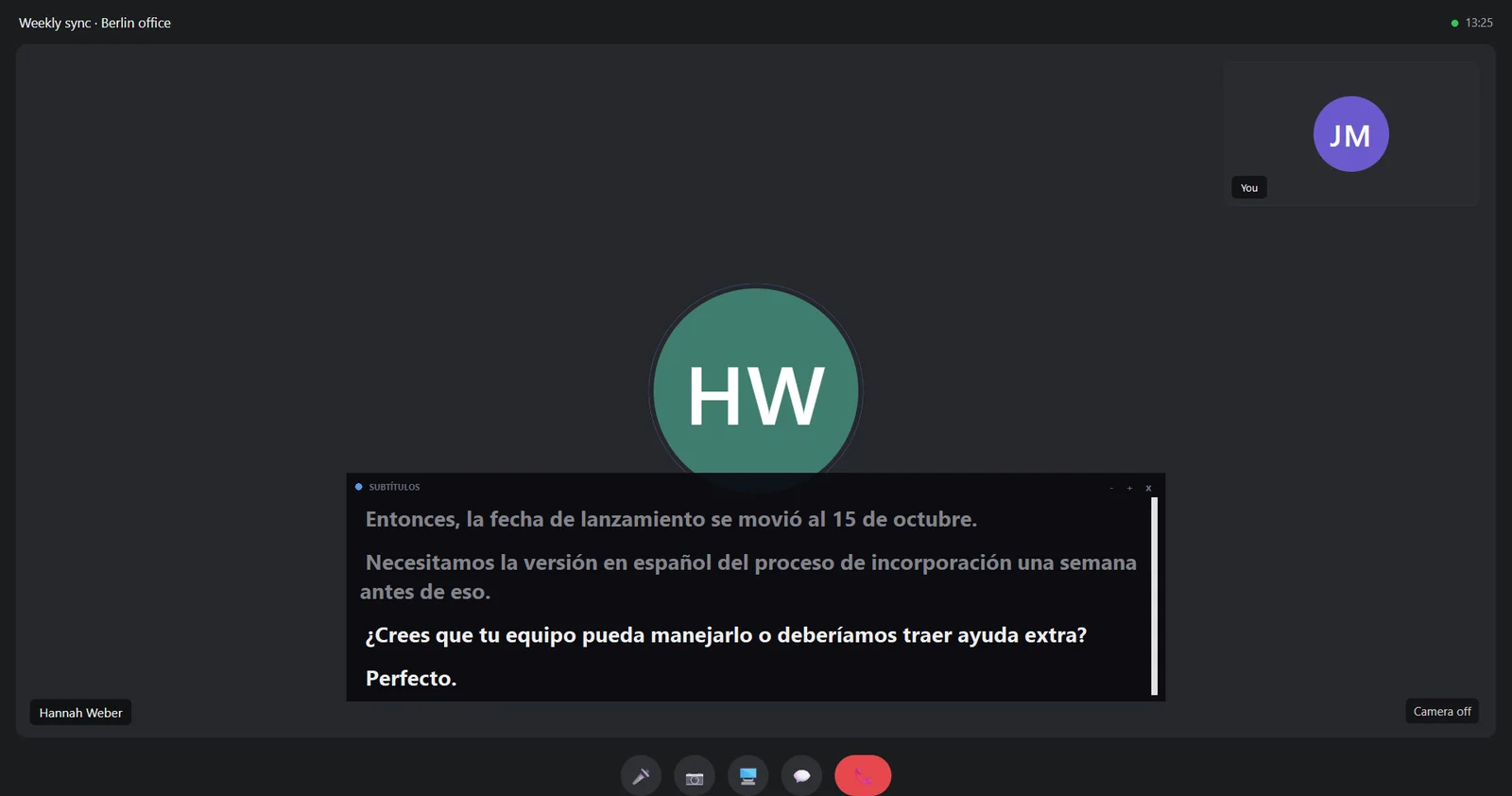
It doesn’t aim to replace a simultaneous interpreter, and we should be clear about that. It doesn’t prepare the topic, it doesn’t know that a “we’ll look into it” might mean no, it doesn’t correct a speaker who gets a figure wrong, and it stumbles over proper nouns. It also isn’t meant for a room: it translates what plays on your computer, for you. What it does do is remove the language barrier in your day-to-day life, for a fraction of the cost. You get 15 free minutes a day, no credit card required, and the plans are on the pricing page.
For what doesn’t need a booth
Subtitles and voice in your language from any Windows app. 15 free minutes a day, no credit card required.
How to become a conference interpreter
In Spain, the usual path starts with a bachelor’s degree in Translation and Interpreting and continues with a master’s degree in conference interpreting, where simultaneous and consecutive interpreting are trained for months using real speeches. The bachelor’s degree provides the linguistic foundation; the booth is learned in the master’s program and, above all, through hours of practice.
European institutions are one of the major employers. To work with them as a freelance interpreter, you must pass an inter-institutional accreditation test, according to their own website. In addition, many professionals belong to associations like AIIC, which requires proven experience and the endorsement of colleagues to join, and which publishes working standards such as team composition.
When hiring a simultaneous interpreter, it isn’t enough for someone to “speak English very well.” Ask about their language combination (A, B, C), their experience in events similar to yours, and whether they work with a regular partner. An untrained bilingual person might hold their own in a conversation, but they won’t last an hour of technical speech in simultaneous mode.
The most common mistakes when hiring simultaneous interpretation
- Asking for a single interpreter for the whole day. No professional accepts this for more than an hour and a half of simultaneous work, and if someone does, the quality will suffer by the afternoon.
- Not sending the documentation. Presentations, written speeches, and the list of speakers, with days to spare. A speech read at top speed without an advance copy is a booth’s worst nightmare.
- Forgetting about videos. If a video with sound is shown, its audio must reach the booth through the mixing console. Otherwise, the interpreter hears nothing.
- Skipping the technical test. In remote events, each speaker should test their microphone and connection before the day. A headset with a microphone changes the outcome.
- Calculating only the fees. Equipment, technician, travel, per diems, and potential recording rights can equal or exceed what the interpreters charge.
More questions about the simultaneous interpreter
What is the difference between consecutive and simultaneous interpretation?
In simultaneous, the interpreter speaks at the same time as the speaker, from a booth and with equipment. In consecutive, the speaker pauses every few minutes and the interpreter reproduces that segment, relying on notes. Consecutive doesn’t need a booth, but it makes the event longer: according to AIIC, it takes roughly twice as much time. It is used in interviews, official visits, and small meetings.
What are the different types of interpreters?
They are usually classified by field: conference interpreters, who work in a booth or remotely; court and sworn interpreters, in trials and events with legal validity; medical and community interpreters, in hospitals and public services; and liaison interpreters, who accompany a person to meetings or visits. Also by technique: simultaneous, consecutive, whispered, or liaison. And sign language, which is its own specialty.
How much does simultaneous translation equipment cost?
Rental companies don’t usually publish fixed prices: they quote based on the number of attendees, languages, and days. The bill includes the booth or portable system, the consoles, a receiver with an earpiece for each attendee, the sound technician, and the setup. For small groups, a portable system is significantly cheaper than a booth.
What are some examples of simultaneous interpretation?
European Parliament plenaries and UN assemblies, international medical conferences, shareholder meetings for companies with foreign investors, press conferences for athletes or executives who speak another language, and, increasingly, Zoom or Teams meetings with attendees from multiple countries who choose their language channel.
So, which one do we use?
It depends on what is at stake. If we were organizing a presentation for clients from another country or a meeting involving a contract, we would hire a simultaneous interpreter with a partner, send them all the material ahead of time, and do a sound check. For day-to-day tasks—understanding a webinar, following a recorded training session, or a call with someone who speaks another language—we use our own voice translator on Windows, which doesn’t replace a person but costs a fraction and is ready in a minute. If you want to compare automatic tools, check out our voice translators comparison.
Understand any video or call in your language
Subtitles and translated voice on Windows, with no booth or technicians. 15 free minutes a day, no credit card required.